Hey everyone, let’s cut to the chase—if you’re working with VFDs (variable frequency drives), you already know they’re game-changers for saving energy and smoothing out motor performance. But here’s the thing: most folks I talk to about VFDs focus on the drive itself, not the cable that connects it to the motor. That’s a mistake. A bad VFD cable? It can turn a perfectly good VFD setup into a noisy, inefficient nightmare—think erratic motor heat, voltage spikes that fry parts, or even downtime that costs you thousands. As a VFD cable supplier, I get questions all the time: how does this stuff actually work? Why can’t I just use a regular old power cable for it? Today, I’m breaking it down like I would with a customer standing right in front of my desk. VFD Cable

First, let’s get the basics straight for anyone new to the party. A VFD’s whole job is to adjust the frequency and voltage going to an AC motor, right? Instead of sending a constant 50Hz (that’s standard grid power in most places, 60Hz in the US), it ramps that up or down to match what the motor needs at any given time—like slowing down a conveyor belt at the end of a shift, or speeding up a pump during peak production. But here’s the catch: when the VFD switches power on and off super fast (that’s called pulse-width modulation, or PWM if you wanna sound like an expert), it doesn’t send a smooth, steady sine wave. It sends short, choppy voltage pulses—like little square waves that jump from 0V to whatever you set, thousands of times a second.
Those pulses are where the problem starts. If you run a standard power cable between the VFD and motor, those fast pulses don’t travel smoothly. They bounce off the motor’s terminals, reflect back down the cable, and slam into the next pulse coming from the VFD. That creates voltage spikes—sometimes two or three times higher than the original voltage. I’ve seen this ruin motor windings in as little as six months, and it’s totally preventable. VFD cables are built to handle that mess, so let’s dig into how.
First, the core structure. Regular power cables have two or three conductors, wrapped in a single layer of insulation, maybe a shield if you’re lucky. VFD cables? They’re layered like a sandwich, but not the kind you eat at lunch. Let’s start with the conductors. We use stranded copper (usually tinned, because it’s more resistant to corrosion) instead of solid. Why? Solid copper is stiff, and when you bend it (which you do all the time on job sites), it can develop hairline cracks that cause resistance. Stranded is flexible, holds up to constant movement, and reduces the skin effect—wait, what’s that? Oh right, at high frequencies, electricity likes to travel on the outside of a conductor, not the inside. So stranded conductors give more surface area, which cuts down on energy loss and heat. That’s a big one for efficiency.
Next, the insulation. Regular power cable insulation is usually PVC, which is cheap and works for steady voltage. But VFD cables deal with those voltage spikes, plus they get warm from all that high-frequency current. Standard PVC can break down over time from the heat and the electrical stress of the spikes. So we use cross-linked polyethylene (XLPE) or ethylene propylene rubber (EPR) for the insulation between the conductors. These materials have way higher thermal resistance—they can handle temps up to 90°C (and even 105°C for heavy-duty setups) without melting or breaking down. They also have better dielectric strength, meaning they don’t let voltage jump between conductors, even when a spike hits.
Then, the shield. This is the part most customers ask me about. There’s two types usually: the overall shield and the individual conductor shields. Wait, let’s keep it simple. The individual shields are thin metal tapes (copper or aluminum) wrapped around each power conductor. Those conductors carry those fast PWM pulses, and if they’re not shielded, they emit radio frequency interference (RFI) that can mess with other equipment nearby—like sensors, PLCs, or even your phone if you get too close. The individual shields contain that noise. Then the overall shield is a thicker copper braid that wraps around all three (or four, if you have a neutral) conductors. That’s for blocking the noise from getting out and also keeping external noise from getting in. Without that overall shield, your VFD might start misbehaving because of interference from other machines on the line.
Wait, also, the jacket. The outer layer of the cable isn’t just for looks. Regular PVC jackets are fine for indoor, low-stress jobs, but most VFD setups are in industrial environments—think factories, warehouses, mines, where cables get stepped on, chewed by rodents, or exposed to oil and chemicals. So we use polyurethane (PU) or chlorinated polyethylene (CPE) jackets for most industrial VFD cables. These are way more durable than regular PVC, resist oil, abrasion, and even cold temps if you’re working outside in winter. I once had a customer who tried using a standard PVC cable in a sawmill—six months later, the jacket was chewed through by rats and the insulation was cracked. Switched to our PU-jacketed VFD cable, and two years later, no issues. That’s the stuff that matters.
Now, let’s talk about how the cable interacts with the VFD’s PWM signals, because that’s where the real “work” happens. When the VFD sends those fast voltage pulses, the cable has a thing called characteristic impedance. That’s a fancy way of saying how much the cable resists the flow of high-frequency current. If the cable’s impedance matches the impedance of the VFD and the motor, those voltage spikes get way smaller. Regular power cables don’t have consistent impedance—their conductors are often the wrong size, insulation thickness varies, so impedance jumps around. That causes those reflections I mentioned earlier. VFD cables are manufactured to strict specs so their impedance stays consistent along the whole length. That eliminates most of the voltage spikes right there.
Also, the length of the cable matters a lot. If the cable is super long (like over 50 feet for small motors, 100 feet for big ones), those reflections get even worse. That’s where we recommend adding a sine wave filter or a dv/dt filter, but the cable still has to be the right type. I’ve seen customers run a 200-foot cable with a cheap regular cable and no filter, and their motor voltage was spiking to 1,200V on a 480V system—total disaster. Switch to a properly built VFD cable, add a small filter, and that spike drops to under 600V, which is totally safe.
Wait, let’s bust a common myth here. Some guys think “bigger conductor = better VFD cable.” No, not exactly. You need the right conductor size for the current, but the insulation and shield are just as important. A 2/0 conductor with regular PVC insulation is still a bad VFD cable. It can’t handle the voltage stress from the PWM pulses. That’s why you can’t just upsize a regular power cable and call it a day.
Another thing: heat. VFD cables carry high-frequency current, which means more energy is lost as heat than in regular power cables. The way we build the cable (stranded conductors, good insulation, proper shielding) helps dissipate that heat. If the cable is too small for the current, or not built right, that heat builds up, which damages the insulation over time. I’ve had customers come to me with cables that failed because they ran them through a hot part of the factory and used the wrong cable—they didn’t realize the VFD’s high-frequency current makes the cable run hotter than a regular power cable.
Let me give you a real example, because numbers make it real. Last year, a packaging plant was having problems with their VFD-driven conveyor motors. Every 8 months, a motor would burn out, costing them $1,500 per motor plus 2 days of downtime. Their electrician told them to just use thicker power cables, which worked a little but not enough. They switched to our standard VFD cables (tinned copper conductors, XLPE insulation, copper braid shield, PU jacket) and added a dv/dt filter. Now, 18 months later, no motor failures. The difference? The VFD cable reduced the voltage spikes by 60%, so the motor windings weren’t taking that stress anymore. That’s the payoff.
So to wrap this up, how does a VFD cable work, exactly? It’s not just a wire connecting two parts. It’s a purpose-built component that’s designed to handle the unique stresses of VFD PWM power: choppy voltage pulses, high-frequency current, electrical interference, and tough industrial environments. Its layered structure (stranded conductors, specialized insulation, multi-level shielding, durable jacket) works together to reduce energy loss, eliminate damaging voltage spikes, block interference, and hold up to wear and tear that regular cables can’t handle.
If you’re running a VFD setup, skimping on the cable is one of the easiest ways to end up with headaches and extra costs. A good VFD cable doesn’t just connect the drive to the motor—it protects your equipment, keeps your system running smoothly, and saves you money in the long run.
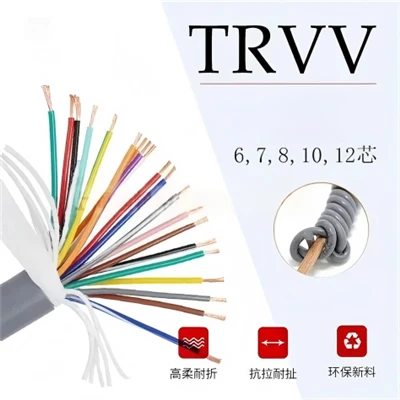
If you’re shopping for VFD cables, or you’re having issues with your current cables (interference, motor failures, frequent breakdowns), hit me up to chat about what you need. I can help you figure out the right size, type, and build for your specific setup—no fancy sales pitches, just straight talk about what works.
Flexible Cable References
- Miller, T.J.E., “Control of Electric Drives”, John Wiley & Sons, 2017.
- Underwriters Laboratories (UL), “Standard for Power and Control Cables for Use in Industrial Machinery”, UL 2575, 2021.
- NEMA (National Electrical Manufacturers Association), “Application Guide for Variable Frequency Drive Cables”, NEMA WD 6, 2019.
- Paul, C.R., “Introduction to Electromagnetic Compatibility”, John Wiley & Sons, 2006.
- Du, Y., et al., “Aging Characteristics of VFD Cable Insulation Under Pulsed Voltage Stress”, IEEE Transactions on Dielectrics and Electrical Insulation, Vol. 22, No. 3, 2015.
Anhui Huawang Cable Co., Ltd.
As one of the most professional vfd cable manufacturers and suppliers in China, we also support customized service. If you’re going to buy discount vfd cable, welcome to get pricelist from our factory. Quality products and reasonable price are available.
Address: No. 32, East Street, Batian Street, Datong Town, Tianchang City, Anhui Province
E-mail: Linda@huawangcable.com
WebSite: https://www.huawang-cable.com/
