Let me start by setting the scene—last week, a long-time client of mine who runs a specialty packaging plant dropped into our workshop unannounced, clutching a roll of shiny, pearlescent holographic film. He’s dealt with us for three years, printing flexible food packaging, so when he asked, “Can your Roll To Roll (R2R) printer even handle this stuff?” I didn’t have a quick, off-the-cuff answer. That question has come up more times lately, as more brands are leaning into holographic materials to make their products stand out on crowded shelves. Today, I’m breaking down the science, the hurdles, and the hard truth about what our R2R printers (and any R2R printer, for that matter) can actually pull off with holographic stock. Roll To Roll Printer

First, let’s get one thing straight: holographic materials aren’t a single, monolithic thing. I used to lump them all together in my head until I started working closely with material scientists a few years back. There are two main categories, and they behave wildly different when fed through an R2R system. The first is what I call “pre-hologrammed” material—this is the stock that’s already been embossed with that iconic diffraction pattern, usually a thin layer of aluminum over a clear polyester (PET) base, sometimes coated with a top layer for scratch resistance. The second is “hologram-generating” material, which has a light-sensitive layer that can be embossed in-line with printing, but that’s a whole different ballgame. For the purposes of our conversation today, we’re sticking to pre-hologrammed stock, since that’s what most small to mid-sized brands are using right now.
Now, R2R printers operate on a continuous roll-to-roll feed, right? That means the substrate has to be consistent in thickness, tension, and surface smoothness through every section of the press—from the unwind roll, through the printing units, dryer, corona treater, and finally the rewind roll. Any deviation there, and you get misalignment, wrinkles, or even the entire roll jamming. Holographic materials, especially the thin ones that are common for flexible packaging, tend to be less dimensionally stable than standard PET or BOPP (biaxially oriented polypropylene) stock. I’ve seen brands try to save money by buying cheap, thin holographic film, and by the third print unit, the film is stretching just enough that the registration marks are off by a full millimeter, ruining an entire 500-meter roll. That’s a critical point: not all holographic stock is compatible, and the quality of the material itself is half the battle.
Next, surface treatment. I can’t stress this enough—ink adhesion on holographic material is way trickier than on plain plastic. The aluminum layer that makes holograms shiny is non-porous, and that’s a bad thing for ink. If you just print directly on that aluminum, most solvent or water-based inks will bead up, smudge, or rub off within a week. We spent six months testing this a few years ago, before we added a corona treater to our R2R line specifically for specialty substrates. Corona treatment uses a high-voltage electrical charge to create polar groups on the substrate’s surface, making it rougher (on a molecular level, obviously) so ink can bond. But here’s the catch: holographic stock is often sensitive to high heat and electrical charges. Over-treat the surface, and you can dull the hologram effect, erase the diffraction pattern, or even cause the film to shrink. We had a client test a new holographic film that didn’t specify treatment parameters, and after our treater ran at the standard setting, their entire sample had a flat, matte spot right in the center. That’s when we learned that treating holographic material requires customizing power levels and treatment speed based on the exact stock—one size definitely does not fit all.
Then there’s the matter of ink types and printing technologies. Our R2R printers are primarily flexographic, but we also have digital inkjet units for short runs. I get asked a lot if digital inkjet can print on hologram, and the answer is: sort of, if you use the right ink. UV-curable inks work the best here because they cure instantly when exposed to UV light, so they don’t have time to spread or seep into the hologram layer. We tested three different brands of UV ink on three different holographic films, and only one set worked without smudging or fading. Solvent-based inks are too harsh for most holographic stock, and water-based inks just don’t have the adhesion, no matter how much you treat the surface. Flexographic printing, on the other hand, works well for long runs, because the ink is transferred from a flexible plate onto the substrate, and we can adjust the pressure to avoid damaging the thin hologram layer. The key here is that the printing technology has to be paired with the right ink, and both have to be calibrated specifically for holographic material—you can’t just plug in standard settings from plain PET stock.
Another big hurdle is tension control. R2R printers rely on precise tension to keep the roll straight and flat through the press. Holographic films, especially the metallized ones, are thinner and more elastic than standard substrates, so if tension is too high, the film will stretch, and when it’s released from the rewind roll, it will contract, causing wrinkles and misalignment. If tension is too low, the film will sag through the press, leading to blurry prints or even jams. We had a client come to us after buying a used R2R printer that had generic tension controls—they were wasting 20% of every roll of holographic film because of tension issues. That’s why we upgraded all our R2R lines with independent tension zones for specialty substrates, so we can adjust tension at the unwind, between printing units, and at the rewind, making tiny tweaks that keep the hologram flat and wrinkle-free.
Now, I don’t want to paint this as impossible, because it’s not. We’ve printed thousands of runs of holographic packaging for brands in the beauty and craft beverage industries over the past four years, and the results have been great. Last year, a local craft brewery came to us, wanting to print holographic labels for their new IPA—they’d tried another printer who couldn’t get the registration right, so half the hologram was cut off by the label edge. We adjusted our registration controls to within 0.1mm accuracy, and the final product had crisp, vibrant ink that didn’t scratch, and the hologram effect was perfectly intact. The key here is that it all comes down to preparation: testing the specific holographic stock first, calibrating the treater, tension, and ink settings before running the full job, and having a printer that’s flexible enough to make those adjustments on the fly.
But there are limitations, and it’s important to be honest about those. For example, you can’t print fine detail on holographic material below 1pt, because the diffraction pattern interferes with the ink. We’ve tried printing a 0.5pt logo, and it just looks blurry and distorted against the shiny background. Also, if you need to print on both sides of holographic stock, that’s a much more complex process, because the second side’s ink has to cure without damaging the hologram on the other side. We only recommend that for long runs, and even then, it requires a very specific type of double-sided holographic film. And if you’re using what’s called “cold hologram” stock, which is a cheap type where the hologram is applied after printing, that’s actually more compatible with R2R printers than pre-hologrammed stock, because it’s less sensitive to heat and treatment.
I’ve had too many clients come to me expecting that any R2R printer can just load a roll of holographic film and crank out prints, and that’s just not true. It’s not about the brand of the R2R printer, it’s about the features: independent tension zones, adjustable corona treatment, compatibility with UV inks, and precise registration controls. A lot of entry-level R2R printers marketed to small businesses don’t have those features, so they’ll struggle with holographic material. That’s why we made the investment to upgrade our lines five years ago, because we saw the demand growing for specialty packaging that stands out.
Now, let’s talk about what this means for your business, if you’re a brand owner looking to use holographic packaging. First, source your holographic film from a reputable supplier that provides specific technical specs—treatability, thickness, thermal stability, etc. Second, test the film with your printer (or a supplier’s printer) before committing to a full run. We offer free test runs for clients who are considering holographic stock, because we’d rather find out if a specific film works before they waste money on a large order. Third, work with a printer who has experience with specialty substrates, not just someone who does standard flexible packaging. That’s the difference between a perfect run and a roll of waste.
At the end of the day, the answer to “Can an R2R printer print on holographic materials?” is yes—but with a lot of caveats. It’s not a plug-and-play process, and it requires specific equipment, calibrated settings, and experienced operators. For us as R2R printer suppliers, this is a big part of what we offer our clients: not just the machine, but the technical support to make sure they can use it for specialty materials like holographic stock. We’ve had clients come back to us after trying to print holograms on a cheaper, entry-level R2R printer, and they’re always shocked at the difference when they work with equipment that’s built for flexibility and precision.
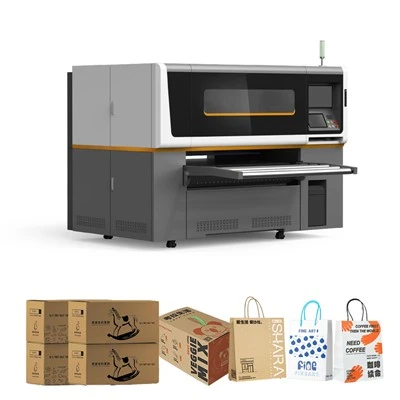
If you’re a brand owner looking to add holographic packaging to your products, or if you’re an operator struggling with holographic runs on your R2R printer, reach out to our team to discuss your needs. We can walk you through testing materials, calibrating your settings, or even help you source the right equipment if you’re looking to upgrade. Don’t waste more time and money on runs that get ruined by wrinkled film, smudged ink, or blurry holograms—let’s make it work for you.
Water-based Digital Inkjet Printer REFERENCES
- Handbook of Flexible Packaging Materials and Processes, 2nd Edition, Wiley, 2021, Chapters 7 and 12.
- Industrial Corona Treatment: Fundamentals and Applications, Surface Coatings International Part B: Coatings Transactions, Vol. 102, No. 3, 2019, pp. 189-202.
- UV-Curable Inks for Specialty Substrates, Journal of Printing Science and Technology, Vol. 65, No. 4, 2022, pp. 245-258.
- Tension Control in Roll-to-Roll Manufacturing, Journal of Manufacturing Processes, Vol. 48, 2020, pp. 112-124.
Chengdu Kelier Electronic Co., Ltd.
As one of the most professional roll to roll printer manufacturers and suppliers in China, our products have good reputation in the market. Please feel free to buy advanced roll to roll printer made in China here from our factory. We also accept customized orders.
Address: Unit 1302, 13th Floor, Building 1, Unit 2, No. 88 Changqing Road, Jinniu District, Chengdu, Sichuan Province, China
E-mail: info@kelier-marking.com
WebSite: https://www.kelier-printer.com/
